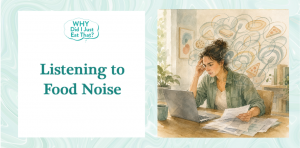
 Food noise is that intrusive, obsessive internal chatter revolving around food so many people struggle with. It’s a new term, but an age-old problem that has increased visibility alongside the rise of diet culture. Diet culture is also another age-old problem; a mostly erroneous assumption that body dissatisfaction can be resolved largely through restrictive dieting. Whether you’re talking about elaborate fad diets or simple calorie-counting, diets all come down to restricting what you eat, and food noise comes from restriction.
Food noise tends to be tangled up with feelings of guilt and shame and self-worth and often grows loudest when food is framed as a moral test, coming in a jumble of shoulds and shouldn’ts. Diet culture promotes all-or-nothing, black and white thinking, a mindset that leads to inflexible restriction. Value judgements about food (labeling some foods good or clean and others bad or junk) leads to inflexible rules around eating. The more rigid the rule, the louder the push-back against that rule. This is a predictable consequence of asking the body and mind to live under deprivation and constant surveillance. Food noise craving food increases because the brain is biologically and emotionally responding to scarcity. When the brain is restricted, the brain signals a need for the denied nutrients it needs to function properly —healthy fats, vitamin rich foods, certain carbs, even dark chocolate!
There is, of course, an emotional element to triggering food noise. Many people use food to self-soothe. If someone who had been using food for comfort denies themselves the very strategy they had relied on to achieve comfort and relief from stress or unhappiness, the craving for that means of that comfort and relief will naturally intensify. It is human nature that the more we are denied something we want, the louder the voice wanting that thing becomes, especially if that thing—food—is easily available and everyone else seems to be enjoying it.
Getting past food noise usually begins with relaxing the all-or-nothing thinking that feeds it. It is important to eat meals and snacks regularly though so the body is not constantly bracing for deprivation. I promote an “all foods fit” philosophy, not labeling foods either good or bad. Unless there are specific reasons to avoid certain food types (i.e. allergies, Celiac Disease or other medical reasons) there is room in all of our diets for all forms of food in appropriate serving sizes.
Many of us are great at second-guessing our thoughts. While this may not be a great habit in all situations, it is certainly worthwhile when it comes to food noise. Consider what issue the food noise is trying to address. Though the urge to eat sometimes comes from physical hunger, it might have nothing to do with hunger in other situations. Carvings might stem from fatigue or stress, loneliness, anger, or boredom, or the need for comfort. (To be clear: there is nothing wrong with finding comfort in food, unless food has become the only reliable source of relief.)
Someone navigating food noise would do well to pause and ask a few questions:
- Have I had regular meals and snacks today?
- Is black and white thinking making me restrict something I want that I don’t need to be so inflexibly restricting?
- Am I thinking about using food to manage anxiety or discomfort when I would be better off finding another way to calm myself?
- Do I simply need a rest or a drink of water?
The take-away is that food noise loses power when we stop fighting with it and consider what it might be trying to tell us.